Welsh slate repair and re-slating specialists. Nail sickness experts. Covering SO40 postcodes.
Tell us the job in 30 seconds. No pushy sales, no call-out fee.
The older properties near Totton High Street and Testwood Lane include Victorian and Edwardian stock with Welsh slate roofs. Totton's Test Valley humidity accelerates nail sickness compared to drier locations — the persistent moisture in the river valley means iron nail corrosion progresses faster than the Southampton average. We carry out slate repair and re-slating on Totton's older properties, with awareness of the moisture conditions that characterise this area.
All prices are guides. Call for a free no-obligation quote specific to your property.
No call-out fee. No obligation. Just an honest quote.
0238 184 9628Mon–Fri 8am–6pm · Sat 8am–2pm · Emergency: 24/7
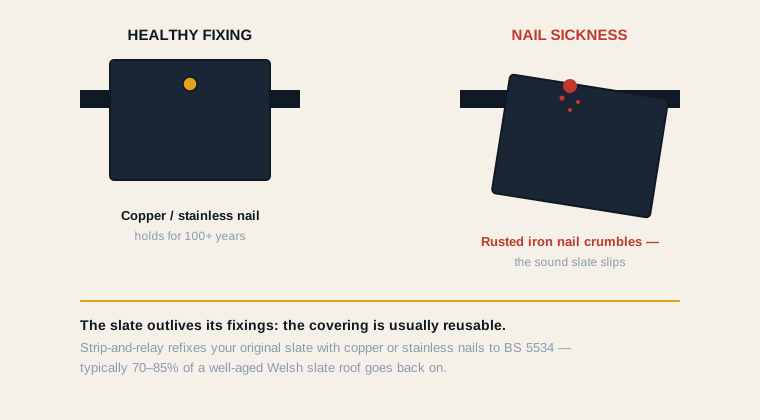
Request Free QuoteThe slate roofs in Totton are concentrated in the 1960s and 1970s Calmore and Testwood estates with older Victorian and Edwardian stock near Totton High Street properties. Welsh slate was the dominant material for roofing built between 1860 and 1920 — fixed with iron cut nails that are now 100 to 130 years old across the Victorian and Edwardian stock. In Test Valley river humidity — one of the dampest locations in Hampshire, iron nail corrosion progresses at an above-average rate compared to drier inland areas. The result is nail sickness — progressive slate slippage as fixings fail.
The crossover between targeted repair and full re-slating is around 25 to 35 percent of slates affected. Below that level, re-fixing displaced slates with stainless clips extends the roof's economic life by 15 to 20 years. Above 35 percent, the remaining sound fixings are insufficient to hold the roof together for another decade — re-slating is the correct financial decision. We assess the proportion affected during the free survey and give you a clear recommendation.
Matching replacement slates to the existing stock on Totton period properties requires sourcing from the correct Welsh quarry family — Penrhyn, Ffestiniog and Nantlle slate each have distinct colour and surface texture characteristics. Spanish slate is cheaper but the visual difference alongside original Welsh material is clearly apparent. On streets in Totton where the uniform roofscape of Victorian and Edwardian properties is part of the street's character, we source matching Welsh slate rather than a cheaper visual approximation.
The slate roofs in Totton are concentrated in the 1960s and 1970s Calmore and Testwood estates with older Victorian and Edwardian stock near Totton High Street properties. Welsh slate was the dominant material for roofing built between 1860 and 1920 — fixed with iron cut nails that are now 100 to 130 years old across the Victorian and Edwardian stock. In Test Valley river humidity — one of the dampest locations in Hampshire, iron nail corrosion progresses at an above-average rate compared to drier inland areas. The result is nail sickness — progressive slate slippage as fixings fail.
The crossover between targeted repair and full re-slating is around 25 to 35 percent of slates affected. Below that level, re-fixing displaced slates with stainless clips extends the roof's economic life by 15 to 20 years. Above 35 percent, the remaining sound fixings are insufficient to hold the roof together for another decade — re-slating is the correct financial decision. We assess the proportion affected during the free survey and give you a clear recommendation.
Matching replacement slates to the existing stock on Totton period properties requires sourcing from the correct Welsh quarry family — Penrhyn, Ffestiniog and Nantlle slate each have distinct colour and surface texture characteristics. Spanish slate is cheaper but the visual difference alongside original Welsh material is clearly apparent. On streets in Totton where the uniform roofscape of Victorian and Edwardian properties is part of the street's character, we source matching Welsh slate rather than a cheaper visual approximation.
Totton’s Victorian terraces are roofed in Welsh slate that outlasts its fixings. Knowing whether to repair, relay or replace saves thousands.
When it is not the answer: If only a few slates have slipped, a repair beats a re-slate; if nail sickness has spread across the slope, patching is money wasted Read the full guide.
We inspect the roof and the void from inside the loft, identify the fault and its cause, and check what is developing next on your Totton property.
You get a clear written quote with any access or scaffold costs shown separately — no call-out fee, no obligation, no vague lump sum.
We book a convenient time, with same-day attendance for genuine emergencies across Totton.
We strip carefully, salvage sound slate, fit breathable underlay and battens, and relay with copper or stainless nails to BS 5534.
We clear all debris, show you the finished work, and hand over the workmanship guarantee.
| Job | Typical duration |
|---|---|
| Slate repair (slipped slates) | 2–4 hours |
| Localised strip-and-relay | 1–2 days |
| Full re-slate — Victorian terrace | 6–10 days |
| Matching-slate sourcing | Adds lead time |
Wet or high-wind days pause work at height safely — we build weather margin into every Totton booking.
Slate roofs on Southampton’s tall Victorian terraces need full scaffold; mid-terrace houses with no side access need a council pavement permit, which we handle. Scaffold is specified for: all re-slating and any repair on a tall three-storey terrace - always itemised in your written quote, never a hidden extra, and we arrange it.
Totton and Calmore have large post-war estates where scaffold access is straightforward but permits run through New Forest District Council. Pavement scaffold and skip permits go through New Forest District Council; allow a few working days on streets like Commercial Road, Rumbridge Street, the older streets near the Test where space is tight.
| Job | Typical range | Notes |
|---|---|---|
| Slate repair (slipped slates) | £150–£400 | Per visit |
| Localised strip-and-relay | £800–£2,000 | Per slope section |
| Full re-slate — terrace | £9,000–£15,000 | Victorian, incl. scaffold |
| Matching Welsh slate | £POA | Sourcing lead time |
| Ridge / hip re-bed | £300–£700 | Per section |
Worked example: a strip-and-relay of a rear slope on a 1960s semi at a post-war semi in Calmore in Totton: around £1,600 including access.
Staged on full re-slates — nothing before materials on site. Repairs paid on completion. Written itemised quote, VAT included where applicable.
Covering SO40 and surrounding postcodes.
Re-slating carries a 10-year workmanship guarantee; salvaged slate is relaid with new stainless or copper fixings that outlast the original iron.
Every Totton job carries the same written 10-year workmanship guarantee, and any materials carry their manufacturer warranties on top.
“Historic England notes that natural slate roofs typically outlast their nail fixings, so a strip-and-relay conserving the original slate is often the appropriate and most sustainable repair on Victorian terraces.”— Historic England / SPAB
A re-slate is a full scaffold-and-skip job with stripping noise by day — but you do not need to be home for external work. You do not need to stay home for external work - we just need power and access agreed in advance.
Slate work runs year-round; stripped areas are made watertight before we leave each day. Totton sits on the Test estuary edge, so waterfront properties see damp, salt-laden air and quick moss regrowth.
Single slate replacement in Totton: £150 to £250. Targeted nail sickness repair: £400 to £1,200. Full re-slate on a 3-bed property: £5,500 to £9,000. Free no-obligation quotes.
On the Victorian and Edwardian properties in Totton with original iron nail fixings, nail sickness is now the dominant roofing issue. The fixings are 100 to 130 years old and failing progressively.
For period properties where the roof is visible from the street, Welsh slate is the correct choice — Spanish slate differs noticeably in colour and surface texture. In conservation areas, Welsh slate may be required by planning guidance.
Yes. Slate repair and re-slating across all of SO40 including Totton and surrounding areas. Free survey and quote on all slate work.
No call-out fee. No obligation. Honest advice from a local roofer.
0238 184 9628