Welsh slate repair and re-slating specialists. Nail sickness experts. Covering SO53 postcodes.
Some of the larger interwar properties in Hiltingbury and around Merdon Avenue were roofed in Welsh slate rather than clay plain tile — these are typically the more substantial detacheds where quality of material was prioritised. Where nail sickness has affected 30 percent or more of the slate on these larger properties, we re-slate in matching Welsh material. The larger roof areas and complex geometry of Hiltingbury detacheds make these more involved re-slating projects than a standard terrace.
All prices are guides. Call for a free no-obligation quote specific to your property.
No call-out fee. No obligation. Just an honest quote.
0238 184 9628Mon–Fri 8am–6pm · Sat 8am–2pm · Emergency: 24/7
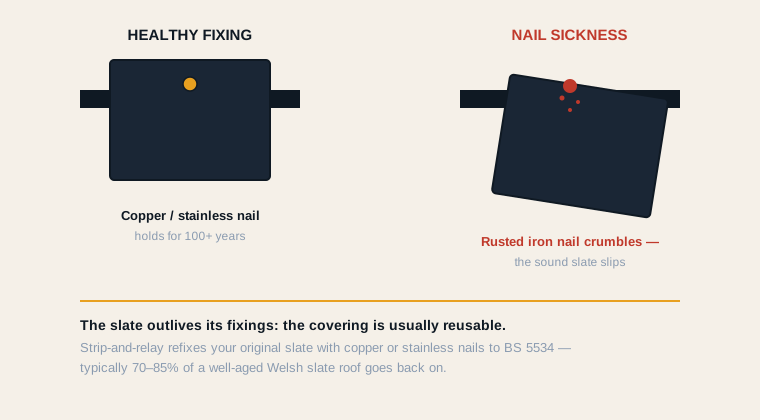
Request Free QuoteThe slate roofs in Chandler's Ford are concentrated in the 1930s to 1960s detacheds and semis with large properties in Hiltingbury and around Merdon Avenue properties. Welsh slate was the dominant material for roofing built between 1860 and 1920 — fixed with iron cut nails that are now 100 to 130 years old across the Victorian and Edwardian stock. In well-drained elevated ground north of Southampton with mature tree canopy, iron nail corrosion progresses at an above-average rate compared to drier inland areas. The result is nail sickness — progressive slate slippage as fixings fail.
The crossover between targeted repair and full re-slating is around 25 to 35 percent of slates affected. Below that level, re-fixing displaced slates with stainless clips extends the roof's economic life by 15 to 20 years. Above 35 percent, the remaining sound fixings are insufficient to hold the roof together for another decade — re-slating is the correct financial decision. We assess the proportion affected during the free survey and give you a clear recommendation.
Matching replacement slates to the existing stock on Chandler's Ford period properties requires sourcing from the correct Welsh quarry family — Penrhyn, Ffestiniog and Nantlle slate each have distinct colour and surface texture characteristics. Spanish slate is cheaper but the visual difference alongside original Welsh material is clearly apparent. On streets in Chandler's Ford where the uniform roofscape of Victorian and Edwardian properties is part of the street's character, we source matching Welsh slate rather than a cheaper visual approximation.
The slate roofs in Chandler's Ford are concentrated in the 1930s to 1960s detacheds and semis with large properties in Hiltingbury and around Merdon Avenue properties. Welsh slate was the dominant material for roofing built between 1860 and 1920 — fixed with iron cut nails that are now 100 to 130 years old across the Victorian and Edwardian stock. In well-drained elevated ground north of Southampton with mature tree canopy, iron nail corrosion progresses at an above-average rate compared to drier inland areas. The result is nail sickness — progressive slate slippage as fixings fail.
The crossover between targeted repair and full re-slating is around 25 to 35 percent of slates affected. Below that level, re-fixing displaced slates with stainless clips extends the roof's economic life by 15 to 20 years. Above 35 percent, the remaining sound fixings are insufficient to hold the roof together for another decade — re-slating is the correct financial decision. We assess the proportion affected during the free survey and give you a clear recommendation.
Matching replacement slates to the existing stock on Chandler's Ford period properties requires sourcing from the correct Welsh quarry family — Penrhyn, Ffestiniog and Nantlle slate each have distinct colour and surface texture characteristics. Spanish slate is cheaper but the visual difference alongside original Welsh material is clearly apparent. On streets in Chandler's Ford where the uniform roofscape of Victorian and Edwardian properties is part of the street's character, we source matching Welsh slate rather than a cheaper visual approximation.
The slate roofs in Chandler's Ford are concentrated in the 1930s to 1960s detacheds and semis with large properties in Hiltingbury and around Merdon Avenue properties. Welsh slate was the dominant material for roofing built between 1860 and 1920 — fixed with iron cut nails that are now 100 to 130 years old across the Victorian and Edwardian stock. In well-drained elevated ground north of Southampton with mature tree canopy, iron nail corrosion progresses at an above-average rate compared to drier inland areas. The result is nail sickness — progressive slate slippage as fixings fail.
The crossover between targeted repair and full re-slating is around 25 to 35 percent of slates affected. Below that level, re-fixing displaced slates with stainless clips extends the roof's economic life by 15 to 20 years. Above 35 percent, the remaining sound fixings are insufficient to hold the roof together for another decade — re-slating is the correct financial decision. We assess the proportion affected during the free survey and give you a clear recommendation.
Matching replacement slates to the existing stock on Chandler's Ford period properties requires sourcing from the correct Welsh quarry family — Penrhyn, Ffestiniog and Nantlle slate each have distinct colour and surface texture characteristics. Spanish slate is cheaper but the visual difference alongside original Welsh material is clearly apparent. On streets in Chandler's Ford where the uniform roofscape of Victorian and Edwardian properties is part of the street's character, we source matching Welsh slate rather than a cheaper visual approximation.
Single slate replacement in Chandler's Ford: £150 to £250. Targeted nail sickness repair: £400 to £1,200. Full re-slate on a 3-bed property: £5,500 to £9,000. Free no-obligation quotes.
On the Victorian and Edwardian properties in Chandler's Ford with original iron nail fixings, nail sickness is now the dominant roofing issue. The fixings are 100 to 130 years old and failing progressively.
For period properties where the roof is visible from the street, Welsh slate is the correct choice — Spanish slate differs noticeably in colour and surface texture. In conservation areas, Welsh slate may be required by planning guidance.
Yes. Slate repair and re-slating across all of SO53 including Chandler's Ford and surrounding areas. Free survey and quote on all slate work.
No call-out fee. No obligation. Honest advice from a local roofer.
0238 184 9628