Roof Repair or Replace?
The honest answer depends on how much has failed, the state of the fixings, and the age of your Southampton roof. Here is the framework we use — and when each option is the wrong call.
Tell us the job in 30 seconds. No pushy sales, no call-out fee.
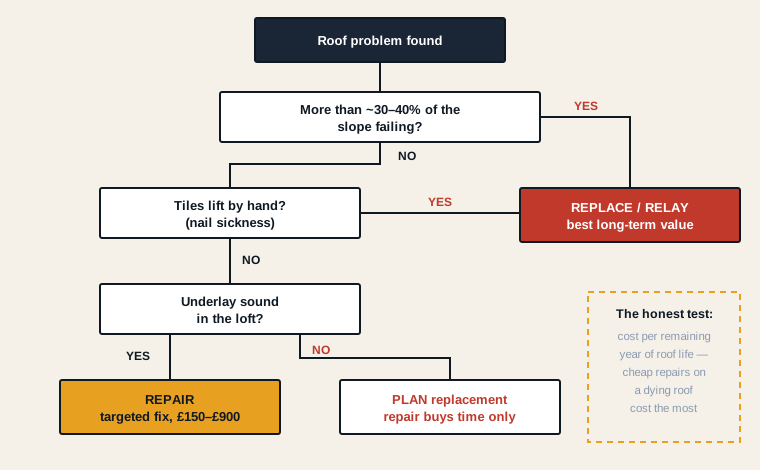
As a rule of thumb, if less than about 30% of the covering has failed and the fixings and underlay are sound, repair. If more than a third has failed, the slates lift by hand (nail sickness), or the underlay has gone, replacement is the better long-term value. Anyone quoting a re-roof for a handful of slipped tiles is overselling.
The Question Behind the Question
Almost every homeowner asking whether to repair or replace is really asking one thing: am I about to be talked into spending thousands I do not need to? It is a fair worry, because roofing is one of the trades where overselling is common. The honest test is not emotional and it is not about age alone — it is cost per remaining year of roof life. A £400 repair that buys five more years costs £80 a year. A £400 repair on a roof that will need replacing in eighteen months costs far more in real terms, because you spend it twice. The framework below is how we reach an honest answer on a Southampton roof, and it cuts both ways: we will tell you when a repair is money wasted, and equally when a re-roof is oversell.
The Decision by Southampton Stock Era
Victorian terraces (Portswood, Bevois Valley, St Denys): these are roofed in Welsh slate that routinely outlasts its Victorian iron nails. When slates start slipping in sequence, that is nail sickness — but the slate itself is usually reusable. The right call is often a strip-and-relay conserving 70–85% of the original slate with new stainless or copper fixings, which sits between a repair and a full replacement in cost and is the most sustainable option.
1930s semis (Bitterne, Shirley, Sholing): clay or early concrete tiles on these roofs can have decades left, but the ridge and verge mortar and the original felt underlay are the weak points. If only the mortar and a few tiles have failed, repair. If the underlay has perished across the roof, a re-roof with breathable underlay is the better value.
Post-war concrete-tile estates (Thornhill, Lordshill, Millbrook): the tiles themselves are durable, but the mortar-bedded ridges and verges fail in the coastal wind. A dry-verge and dry-ridge conversion is frequently the answer — not a full re-roof — extending the roof’s life for a fraction of the cost.
How We Apply the 30% Rule
1. How much has failed?
We assess what proportion of the covering is genuinely at end of life, not just what is currently leaking. Under ~30% and sound elsewhere points to repair.
2. Do the fixings hold?
If slates or tiles lift by hand across a slope, the fixings have gone (nail sickness) and spot repairs will not hold — that points to strip-and-relay or replacement.
3. Is the underlay sound?
We check the underlay from inside the loft. Perished felt across the roof is the difference between a repair buying a few years and a re-roof being the honest call.
4. Cost per remaining year
We put numbers to both options so you can see the real cost of each per year of roof life — and we recommend the one that is genuinely better value, not the bigger invoice.
When Repair Is Wasted — and When Replacement Is Oversell
When patching is money wasted: once nail sickness has spread across a whole slope, or the underlay has perished, or you are on your third patch-repair in as many years, spot repairs are throwing good money after bad. Each fix holds for a season and the next failure is always somewhere new.
When replacement is oversell: a sound roof with one failed detail — a slipped ridge, a cracked flashing, a blocked valley — needs that detail fixed, not a new roof. If a quote proposes a full re-roof without anyone having been into the loft, or without explaining why the covering as a whole has failed, be sceptical. A roof with twenty good years left does not need replacing because a dozen tiles slipped in a gale.
What Each Option Costs in Southampton
| Option | Typical range | When it is right |
|---|---|---|
| Targeted repair | £150–£900 | Under ~30% failed, fixings and underlay sound |
| Strip-and-relay (slate) | £800–£2,000 / slope | Nail sickness, slate reusable |
| Dry-verge / ridge conversion | £900–£1,600 | Post-war tile, mortar edges failing |
| Full re-roof — semi | £5,500–£11,000 | Widespread failure or perished underlay |
| Full re-slate — terrace | £9,000–£15,000 | Slate at end of life, not reusable |
Prices include scaffold where needed. The cheapest option over ten years is rarely the cheapest today — it is the one with the lowest cost per remaining year.
Covering SO17 and surrounding postcodes.
“RICS and BRE stock-condition guidance assess a roof on the remaining serviceable life of the covering and its fixings, not age alone — a well-maintained roof can outlast its nominal design life by decades.”— RICS / BRE stock-condition guidance
The Southampton Coastal Factor
One thing that shifts the repair-versus-replace calculation on the south coast is exposure. Southampton’s position at the head of Southampton Water means salt-laden air and south-westerly Solent gales work on a roof harder than an inland site. Salt accelerates the corrosion of nails, flashings and metal fixings, which is why nail sickness shows earlier here than in a sheltered inland town, and why we always specify stainless or copper fixings on any relay or repair — galvanised fixings in this climate fail faster than the manufacturer’s figures suggest. Wind exposure also lifts poorly-bedded ridge and verge tiles, which is why so many post-war estates in the exposed east and north-west of the city — Thornhill, Lordshill — are candidates for dry-fix conversion rather than repeated mortar re-bedding. Factoring the coastal climate in is the difference between a repair that lasts and one that fails the following winter.
How We Keep the Advice Honest
Because we own the reputation of this business locally, an honest recommendation is worth more to us than a single inflated invoice. When we survey a roof we put both options in writing where both are viable, with real numbers, and explain which we would choose and why. If a repair is the right answer we say so, even though a re-roof would be the bigger job. If replacement is genuinely overdue we explain exactly which evidence points that way — the extent of failure, the state of the fixings, the condition of the underlay from inside the loft — so you can see the reasoning rather than take it on trust. You are always free to get the roof looked at, take our written assessment, and decide in your own time. There is no call-out fee and no pressure to commit on the day. See how we work and our roof inspection service for a costed condition report.
Frequently Asked Questions
The 30% rule of thumb: if less than about a third of the covering has failed and the fixings and underlay are sound, repair. More than a third, or nail sickness across a slope, points to replacement.
No. Age is a factor but not the deciding one. A well-maintained Welsh slate roof on a Southampton terrace can outlast its nominal life by decades if the fixings and underlay are sound.
It is when the iron nails holding slates corrode and fail, so sound slates slip one after another. The slate is usually reusable — a strip-and-relay with new fixings is often the answer, not a full replacement.
Be sceptical of any re-roof quote given without someone inspecting the loft, or without a clear explanation of why the whole covering has failed rather than one detail.
It is the honest way to compare options: a cheap repair on a dying roof costs more in real terms because you pay again soon. We put numbers to both so you can see the real value.
Usually yes — on a Victorian Southampton terrace a strip-and-relay typically salvages 70–85% of the original Welsh slate, refixed with stainless or copper nails.
Frequently. A sound roof with one failed detail needs that detail fixed, not a new roof. We will tell you honestly when a repair is the right call.