How Much Does a New Roof Cost in Southampton?
A new roof in Southampton typically costs between £5,500 and £15,000 depending on the size of the property, the pitch and complexity of the roof, the covering material chosen and the condition of the underlying structure. A straightforward re-roof of a three-bedroom terraced house sits at the lower end; a large detached property with multiple valleys, dormers and chimney stacks sits at the upper end. Heritage properties requiring matching Welsh slate or hand-made clay tiles can exceed these figures.
The single biggest cost variable is the roof covering. Concrete interlocking tile is the most economical, natural clay plain tile costs more, and natural Welsh slate is the most expensive of the common Southampton options. Labour is the second variable, and re-roofing labour in Southampton sits at the southern-England baseline — neither the London premium nor the discounts seen in parts of the north and Scotland.
What's Included in a Full Re-Roof
A complete re-roof is not simply new tiles. A proper Southampton re-roof includes: stripping the existing covering and disposing of it, inspecting and replacing damaged roof timbers and battens, fitting modern breathable underlay, installing new tiles or slates with stainless steel fixings, re-bedding or dry-fixing the ridge and hips, renewing all lead flashings at chimneys and abutments, and fitting new eaves protection and ventilation. Anyone quoting significantly below the ranges here is usually omitting one or more of these elements.
What Drives New Roof Costs Across Southampton's Neighbourhoods
Southampton's enormous variety of housing stock means the cost of a new roof varies sharply by area. The Victorian terraces of Portswood, St Denys and Bevois Valley have steep-pitched Welsh slate roofs, often with complex valley arrangements between the main roof and rear back-additions. Re-slating these in matching Welsh slate — essential where the street has a uniform Victorian roofscape — pushes costs toward the higher end at roughly £180 to £280 per square metre. The narrow terraced streets off Portswood Road also add an access premium: scaffold and skip placement often requires a permit from Southampton City Council, and materials must be carried further from the road.
By contrast, the interwar semis of Bitterne, Shirley and Sholing typically have clay plain tile or early concrete tile at a shallower pitch. These re-roof more economically — the roofs are simpler, access is easier on the wider 1930s streets, and clay plain tile at £160 to £250 per square metre is less costly than slate. The post-war estates of Thornhill, Lordshill and Weston have concrete interlocking tile, the cheapest to replace, and their roofs are the most straightforward of all Southampton stock.
Conservation Area Premium
Properties in Southampton's conservation areas — parts of Portswood, Highfield and Bitterne Manor — carry a material premium of roughly 20 to 40 per cent because planning policy requires the replacement covering to match the original. On these properties, natural Welsh slate cannot be substituted with cheaper fibre-cement or Spanish slate, and chimney repointing must use lime mortar rather than cement. Budget accordingly if your home is in one of these areas.
Worked Example — 1930s Semi in Bitterne
A typical three-bedroom 1930s semi-detached in Bitterne with a clay plain tile roof, one chimney stack and a simple double-pitch layout would cost roughly £7,000 to £9,500 for a full re-roof: stripping and disposal, new breathable underlay and battens, matching clay plain tiles, new lead flashing to the stack, dry-ridge system and new eaves ventilation, including scaffold. A comparable Victorian terrace in Portswood requiring matching Welsh slate would run £9,000 to £13,000 for the same footprint because of the material and access differences.
When Does a Roof Actually Need Replacing?
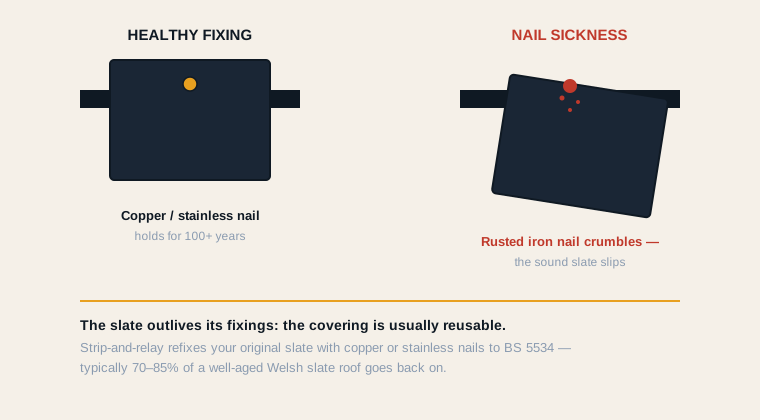
Not every ageing roof needs replacing, and an honest Southampton roofer will tell you so. A roof is a genuine re-roofing candidate when tiles or slates are failing across the whole roof rather than in isolated spots, when nail sickness affects more than a third of the slates, when the roof has been patch-repaired repeatedly and the repairs are no longer holding, or when the underlying timber or underlay has failed. On Southampton's Victorian stock the trigger is usually widespread nail sickness; on the post-war estates it is concrete tiles failing at the nib in volume. If your roof is over fifty years old and you are calling a roofer more than once a year, a re-roof usually works out cheaper over the following decade than continued repairs.
Materials and Longevity — Getting Value from a New Roof
A new roof is a thirty-to-hundred-year decision, so the material choice matters more than the initial price. Concrete interlocking tile is cheapest but has the shortest life, typically forty to sixty years, and erodes faster in Southampton's salt-influenced coastal air. Clay plain tile lasts sixty to eighty years and holds its colour far better. Natural Welsh slate, correctly fixed with stainless or copper nails, lasts eighty to a hundred years or more and is the only appropriate choice on Southampton's Victorian conservation-area streets. Spending more on the covering usually reduces the whole-life cost, because a cheap re-roof that lasts forty years costs more over a century than a quality one that lasts eighty. We talk through the trade-offs honestly at survey so you can weigh initial cost against longevity for your specific property and how long you plan to stay.
Ventilation and Underlay — The Hidden Half of a New Roof
Two elements homeowners rarely think about make an enormous difference to how long a Southampton roof lasts: ventilation and underlay. Modern breathable underlay allows moisture vapour to escape the roof void, which matters enormously in Southampton's humid coastal climate where condensation is a constant threat. The old bitumen felt underlay traps that moisture, rotting timbers from within. Correct eaves and ridge ventilation completes the airflow. A re-roof that skimps on these — using cheap non-breathable underlay or omitting ventilation to shave the price — will look fine for a few years and then develop condensation and timber-rot problems that cost far more to put right than the saving. Every re-roof we quote includes breathable underlay and correct ventilation as standard, not as an upsell.
New Roof Cost Breakdown — Southampton 2026
| Roof Type / Property | Typical Cost |
|---|
| Concrete tile re-roof — 3-bed terrace | £5,500–£7,500 |
| Clay plain tile re-roof — 3-bed semi | £7,000–£9,500 |
| Welsh slate re-roof — 3-bed Victorian terrace | £9,000–£13,000 |
| Large detached (complex roof) | £11,000–£15,000+ |
| Welsh slate (supply + fit) | £180–£280/m² |
| Clay plain tile (supply + fit) | £160–£250/m² |
| Concrete interlocking tile (supply + fit) | £120–£180/m² |
| Scaffold (typical semi) | £800–£1,800 |
All figures are indicative 2026 Southampton prices including labour at the southern-England baseline. Every job is quoted free after a survey — call 0238 184 9628 for an itemised quote specific to your property.
Under BS 5534, the British Standard for slating and tiling, all new roofs must be mechanically fixed to resist wind uplift — the mortar-only bedding of ridge tiles common on older Southampton roofs no longer meets the standard.
Source: British Standard BS 5534 (2018 revision)
Not sure whether you need a full re-roof or a repair? A professional roof inspection gives you an honest, costed answer before you commit. If your roof has isolated problems rather than widespread failure, our roof repairs may be the more economical route.
Get a Free Quote in Southampton
No call-out fee. No obligation. Honest advice from a local roofer. Call 0238 184 9628.
Call 0238 184 9628