Specialist lead flashings, valleys and chimney work. All to Lead Sheet Association standards. Covering SO50.
The Victorian and Edwardian terraces near Eastleigh Station have chimney stacks where lead flashing is the most common repair call we receive. Original stepped flashing at the sides of these stacks and back gutter flashings at the rear junction have in many cases never been replaced — they are now well over 100 years old and failing progressively. We replace all lead flashings on Eastleigh period properties to correct specification — properly dressed lead, never mastic.
All prices are guides. Call for a free no-obligation quote specific to your property.
No call-out fee. No obligation. Just an honest quote.
0238 184 9628Mon–Fri 8am–6pm · Sat 8am–2pm · Emergency: 24/7
Request Free QuoteLead flashings in Eastleigh fail through three primary mechanisms: thermal movement cracking where flashing is fixed too tightly without movement provision, failed mortar pointing that secures step flashings to the brick course, and in Itchen valley humidity from Bishopstoke, accelerated oxidation of the lead surface. On waterfront and exposed properties, the higher salt concentration in Eastleigh accelerates surface deterioration faster than inland equivalents. We identify the failure mode during inspection and address the cause rather than patching the symptom with mastic.
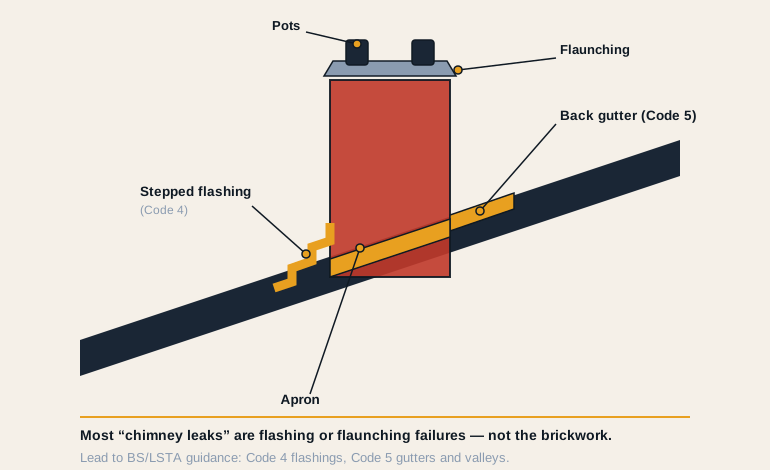
Lead code specification is critical to longevity. Code 4 for step flashings and soakers. Code 5 for back gutters, valleys and bay roofs. Code 6 and above for parapet gutters and flat roof sections. We specify the correct code for each application — using undersized lead on a Eastleigh property exposed to Itchen valley humidity from Bishopstoke leads to early failure and repeat calls. All leadwork is carried out to Lead Sheet Association standards.
Mastic sealant applied over failed lead flashings is a temporary patch that lasts 2 to 3 years before failing again. Correctly dressed and fixed lead lasts 50 to 80 years. On any Eastleigh property we work on, mastic is not used as a substitute for correct lead work. Where we find previous mastic applications, we strip them out and execute the junction correctly in properly dressed lead.
Lead flashings in Eastleigh fail through three primary mechanisms: thermal movement cracking where flashing is fixed too tightly without movement provision, failed mortar pointing that secures step flashings to the brick course, and in Itchen valley humidity from Bishopstoke, accelerated oxidation of the lead surface. On waterfront and exposed properties, the higher salt concentration in Eastleigh accelerates surface deterioration faster than inland equivalents. We identify the failure mode during inspection and address the cause rather than patching the symptom with mastic.
Lead code specification is critical to longevity. Code 4 for step flashings and soakers. Code 5 for back gutters, valleys and bay roofs. Code 6 and above for parapet gutters and flat roof sections. We specify the correct code for each application — using undersized lead on a Eastleigh property exposed to Itchen valley humidity from Bishopstoke leads to early failure and repeat calls. All leadwork is carried out to Lead Sheet Association standards.
Mastic sealant applied over failed lead flashings is a temporary patch that lasts 2 to 3 years before failing again. Correctly dressed and fixed lead lasts 50 to 80 years. On any Eastleigh property we work on, mastic is not used as a substitute for correct lead work. Where we find previous mastic applications, we strip them out and execute the junction correctly in properly dressed lead.
Lead flashings in Eastleigh fail through three primary mechanisms: thermal movement cracking where flashing is fixed too tightly without movement provision, failed mortar pointing that secures step flashings to the brick course, and in Itchen valley humidity from Bishopstoke, accelerated oxidation of the lead surface. On waterfront and exposed properties, the higher salt concentration in Eastleigh accelerates surface deterioration faster than inland equivalents. We identify the failure mode during inspection and address the cause rather than patching the symptom with mastic.
Lead code specification is critical to longevity. Code 4 for step flashings and soakers. Code 5 for back gutters, valleys and bay roofs. Code 6 and above for parapet gutters and flat roof sections. We specify the correct code for each application — using undersized lead on a Eastleigh property exposed to Itchen valley humidity from Bishopstoke leads to early failure and repeat calls. All leadwork is carried out to Lead Sheet Association standards.
Mastic sealant applied over failed lead flashings is a temporary patch that lasts 2 to 3 years before failing again. Correctly dressed and fixed lead lasts 50 to 80 years. On any Eastleigh property we work on, mastic is not used as a substitute for correct lead work. Where we find previous mastic applications, we strip them out and execute the junction correctly in properly dressed lead.
Chimney step flashing in Eastleigh: £250 to £600. Back gutter: £200 to £450. Lead valley per valley: £400 to £1,000. Free no-obligation quotes on all leadwork.
Mastic is a temporary sealant that fails within a few years. Correctly dressed lead lasts 50 to 80 years. We do not use mastic as a substitute for lead work.
Yes. Lead flashing failure causing active water ingress is treated as an emergency — same-day attendance across Eastleigh and all SO50. No call-out fee.
Code 4 for step flashings and soakers. Code 5 for back gutters and valleys. Code 6 for parapet gutters and flat roof work. We specify correctly for each application.
No call-out fee. No obligation. Honest advice from a local roofer.
0238 184 9628